The Ultimate 2026 AI Marketing Tool Stack for 1-Person Empires

What is the best AI marketing tool stack for 2026? The best AI marketing tool stack in 2026 abandons the fragmented “15-tool” approach and relies on a 2-Tool Architecture. You need one platform to act as your unified data layer (funnels, emails, and CRM) and one platform to act as your agentic workflow engine (content generation and research). This consolidation eliminates the “Zapier Tax,” prevents API breakdowns, and drastically increases the profit margins of a 1-Person Empire.
If you search for the “Best Marketing Tools” on YouTube or Google, you will usually find lists of 20 different software subscriptions. One tool for SEO writing, another for building landing pages, a third for email marketing, a fourth for hosting courses, and a fifth to connect them all together.
While enterprise companies with massive budgets and dedicated IT teams can afford this complexity, it is financial suicide for a Solopreneur. In 2026, the key to scaling your business without scaling your stress is Radical Consolidation.
The Hidden Cost of Fragmentation
When you duct-tape multiple tools together, you aren’t just paying for the monthly subscriptions. You are paying a hidden tax in time and data loss.
1. The “Zapier Tax”
If your landing page builder (e.g., ClickFunnels) doesn’t natively communicate with your email provider (e.g., ActiveCampaign), you have to use a middleware tool like Zapier. Every time a customer opts in, a “Zap” fires. As your traffic scales, your Zapier bill scales exponentially. You are literally being taxed for having a fragmented system.
2. Broken Data Loops
When data moves between three different platforms, things break. API keys expire, webhooks misfire, and suddenly you realize that 500 new leads never received your welcome email because a third-party integration failed silently.
3. The Context Window Problem (AI Fragmentation)
If you use a generic AI chatbot to write your content, you suffer from the “Blank Slate Tax.” Every time you open a new chat, the AI forgets your brand voice, your formatting rules, and your strategic goals. You spend more time writing prompts than producing content.
The 2-Tool Architecture (The 1-Person Empire Blueprint)
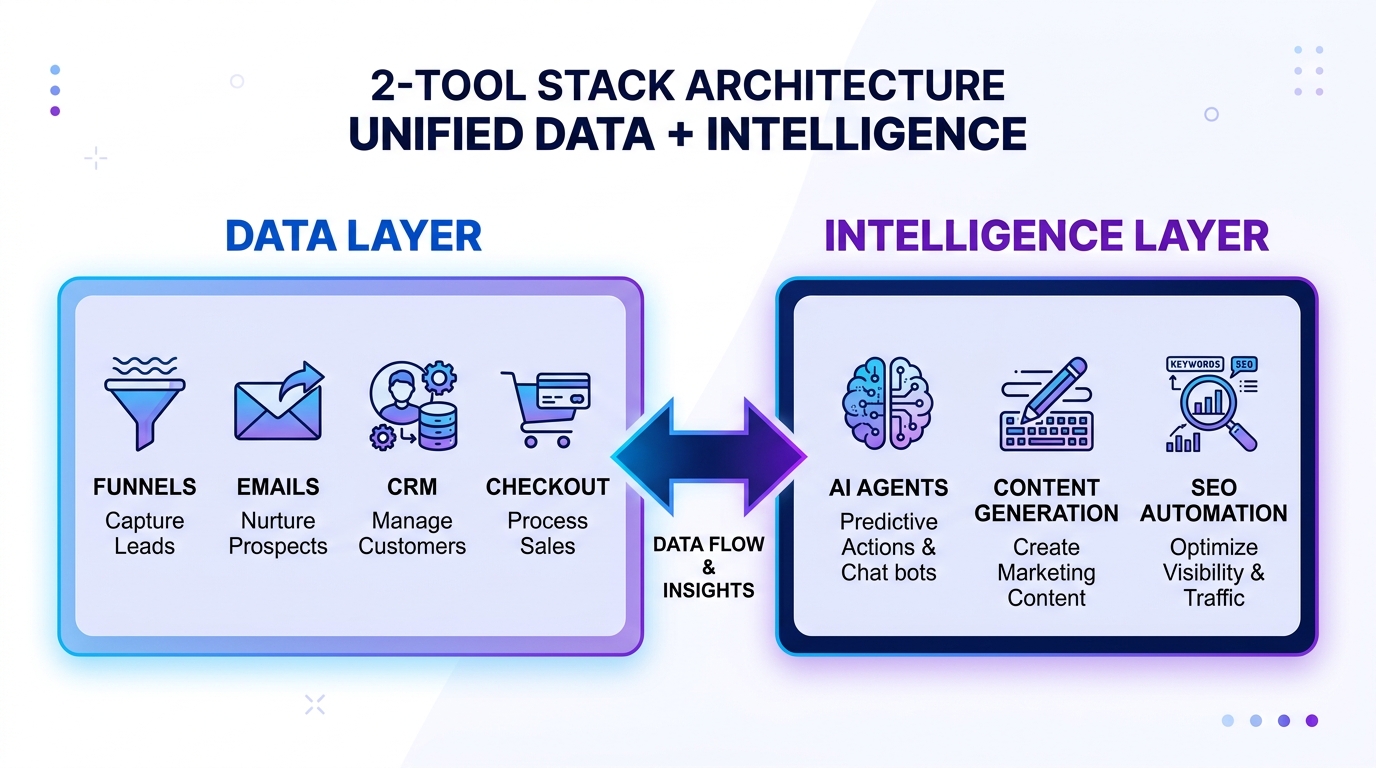
To build a highly profitable, automated business, you need an architecture that minimizes moving parts. We break our entire operation down into two layers: The Data Layer and The Intelligence Layer.
The architecture looks like this:
1. The Data Layer: Consolidation and Execution
Your Data Layer is where your business “lives.” It hosts your website, captures your leads, processes your payments, and sends your emails.
The Strategy: Do not separate these functions. Your CRM, your funnels, and your email autoresponder must share the exact same database. When a user buys a product, the system should immediately tag them and remove them from the promotional email sequence without needing a single Zapier integration.
The Tool: We use Systeme.io for this layer. It is a unified platform that replaces WordPress, ClickFunnels, Mailchimp, and Kajabi. Because everything is under one roof, automation rules execute natively and instantly. This single consolidation saves the average Solopreneur over $300/month.
2. The Intelligence Layer: Agentic Workflows
Your Intelligence Layer is the engine that drives traffic and handles research. It acts as your automated marketing department.
The Strategy: Stop using naked prompts. Instead, build Skills (Standard Operating Procedures) and assign them to specialized AI Agents. You need an agent that researches SEO gaps, an agent that writes structurally optimized content, and an agent that repurposes long-form content into social media posts.
The Tool: We use Agent Kit to orchestrate this. It allows you to build a multi-agent system. Instead of typing “Write a blog post,” you trigger a command. The “Planner Agent” researches the topic, hands the data to the “Content Writer Agent” (which strictly follows your brand guidelines), and outputs a finished asset ready to be pasted into your Data Layer.
Your Implementation Action Plan
Transitioning to a 2-Tool Architecture takes a weekend but pays dividends for years.
- Audit Your Stack: List every software subscription you currently pay for.
- Establish the Data Layer: Move your funnels and email lists to a unified database like Systeme.io. Cancel your standalone email and landing page subscriptions.
- Establish the Intelligence Layer: Start converting your most repetitive marketing prompts into formalized Agents using a workflow engine like Agent Kit.
- Connect the Loop: Use your AI agents to generate high-quality SEO content, host it on your unified platform, and capture the resulting traffic into your automated email sequences.
By simplifying your technology, you free up the mental bandwidth necessary to focus on what actually grows a business: Strategy and Audience Building.
Want to dive deeper into why this consolidation is crucial? Read our breakdown on The Best Marketing Automation Software for a Solopreneur.
This article is a “Hub” in our AI Marketing series. To see how these tools compare to older software, read our deep dive on Systeme.io vs ClickFunnels.
Disclaimer: This post contains affiliate links. If you purchase through these links, we may earn a commission at no extra cost to you. This is how we fund our 1-Person Empire.