Agent Kit for Marketing Playbook: The Complete 2026 Agent Workflow
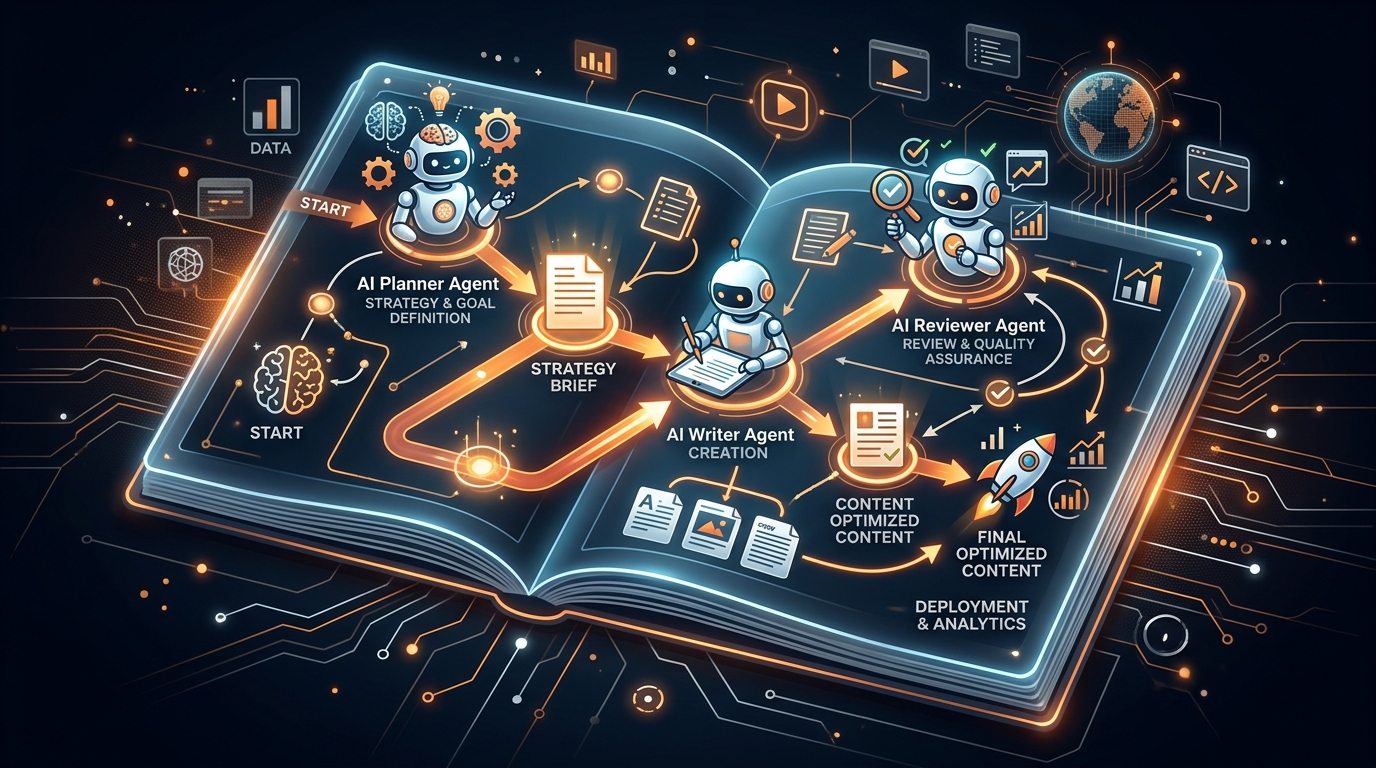
How do you automate marketing with AI Agents? To build an automated marketing workflow with Agent Kit in 2026, you must stop treating AI as a simple chatbot and start treating it as a multi-agent system. By employing an Agent Handoff methodology, you can assign specialized roles (e.g., a Planner Agent, a Content Agent, and an SEO Reviewer Agent) that pass data to one another systematically. This eliminates the “Blank Slate Tax” and produces enterprise-grade marketing assets on autopilot.
When people first explore AI for marketing, they usually open a blank chat window and type “Write a blog post about X.” While this is a great starting point, the output is almost always generic. It lacks depth, it ignores your brand guidelines, and it fails to rank on Google.
To truly leverage AI as a 1-Person Empire, you need to upgrade your methodology from “Prompting” to “Agentic Workflows.” Here is the exact playbook to build an automated marketing department.
1. The Bottleneck: The “Blank Slate Tax”
The biggest challenge in AI marketing is what we call the “Blank Slate Tax.” Every time you open a new chat window, the AI has zero context about who you are.
- Context Loss: In long conversations, standard chat interfaces suffer from “Token Amnesia.” They forget your earlier instructions.
- Manual Overhead: You spend 30 minutes writing the perfect 1,000-word prompt, only to realize you have to manually copy, format, and paste the output into your CMS.
- Inconsistent Quality: Because the AI starts fresh every time, the tone and structure of your articles vary wildly from day to day.
If you are manually prompting every piece of content, you are still trading time for money. You have just replaced typing with prompting.
2. The Solution: Encoded Skills and Agent Handoffs
The modern approach is to build an automated assembly line. Instead of giving one AI a massive task, you break the task down into specialized Skills (Standard Operating Procedures) and assign them to specific Agents.
The Handoff Methodology
Imagine a real-world marketing agency. The SEO Manager does the research, passes the brief to the Copywriter, who then passes the draft to the Editor. You can replicate this exact workflow using AI.
- The Planner Agent: This agent’s only job is to research the target topic and create a structural outline. It outputs a
.mdfile containing the brief. - The Content Agent: This agent reads the brief generated by the Planner. It applies your brand voice and writes the actual draft.
- The Reviewer Agent: This agent reads the draft, checks it against your SEO rules, and ensures the formatting is perfect.
Because each agent only focuses on one micro-task, the quality of the output skyrockets. More importantly, this happens automatically. The agents hand off the data to each other without you needing to intervene.
3. Implementing the Workflow Engine
To execute this, you need a workflow engine that can manage multiple agents simultaneously.
We use Agent Kit to orchestrate this assembly line. Agent Kit acts as a layer on top of Anthropic’s Claude Code, allowing you to define these Agents and their specific Skills.
According to the official documentation, you can set up a command like /ck:plan. When you type this, the system automatically wakes up the Planner Agent, conducts the research, and seamlessly hands the data over to the next agent in the sequence. You completely bypass the Blank Slate Tax.
Your Workflow Automation Checklist
If you are ready to stop prompting and start automating, here is your action plan:
- Map Your Process: Write down exactly how you write an article by hand (Research -> Outline -> Draft -> Edit).
- Get the Engine: Look into agent frameworks like Agent Kit to understand how they structure tasks.
- Encode Your Skills: Take your best, most effective prompts and save them as repeatable Skills within the engine.
- Automate the Distribution: Once your Agent spits out the final article, upload it to a unified platform like Systeme.io to automatically capture email leads from the generated traffic.
By treating AI as a team of specialized agents following clear, structured handoffs, you guarantee a consistent flow of high-quality content.
This article is a “Hub” in our AI Marketing series. To learn how to convert the traffic these agents generate, read our guide on Starting Affiliate Marketing.
Disclaimer: This post contains affiliate links. If you purchase through these links, we may earn a commission at no extra cost to you. This is how we fund our 1-Person Empire.